
Developer Note: Images are not available yet. They're planned for a future update.
Contents
- Game board
- 24 Company deeds
- 5 Player aids
- 214 Goods markers: 54 rice, 44 spices, 40 rubber, 40 siap faji and 36 oil
- 30 Player markers: 6 wooden disks in each colour
- 15 City cards
- 48 Ships: 6 sets of 8 ships
- Money: 40 coins each of 1 and 5 rupiah and banknotes of 10, 50, 100 and 500 rupiah (respectively 40, 30, 30 and 20 of each)
- 23 City markers: 12 city size 1, 8 city size 2, 3 city size 3 markers
- Game rulebook
Introducing the Game
Judging by the smirk on the face of the Sultan of Solo, the businessman from North Sumatra has just made a mistake, and a costly one at that, too. He has paid way too much for merging his rubber company with the Sultan's extensive rubber plantations: there are no ships in the area to transport the rubber to the booming cities of Java. And the Sultan is now dripping in cash - he can bribe city authorities so that his ships will gain preferential access to those ports where they are competing. Or he might invest in building an oil imperium.
But wait - what's that young fellow over there up to? Buying all the shipping lines? That might change the outlook considerably; in fact... let's see...
Indonesia is a game in which 2-5 players build up an economy. As the game unfolds, the basic agricultural economy develops into early industry - the players getting rich in the meantime by producing and transporting goods, and by acquiring and merging companies at the right time, and for the right price. The game takes three to four hours to complete.
Overview
Indonesia is a game about getting rich. Whoever has the most money at the end of the game, wins. In order to earn rupiah players will start companies and operate them. There are two kinds of companies: production companies, and shipping companies. The shipping companies move goods produced by production companies to cities. This earns the owners of both companies some money, depending on which goods are sold and how far they have to be transported.
Successful companies grow, as do cities that are supplied by enough materials. In addition, players can invest in era research, and they can speed up the development of the economy so that new types of products become available. As the economy grows, players will develop strategic positions that they need to consolidate or defend. This they do by merging their own companies, or those of other players, into business imperiums that may stretch across the entire archipelago.
Setup & Phase Overview
Setup
- Give each player a player aid and 100 rupiah.
- Sort the city building cards into three piles (a, b and c). Deal each player one card of each pile.
- Hand each player a set of wooden player markers of one color. Each player places a marker on the first slot of each of the R&D tracks.
- Randomly select the player order and indicate this on the order of play track.
- Sort the company deeds into three sets (a, b and c) and place the first set (the a's) on their respective provinces (you can use the coordinate system to find locations easily).
- Agree if money will be open or closed. We prefer to play with players not revealing the amount of money they have but tastes differ. If you forget to agree, the amount of money players have will be secret.
- The game is now ready to start.
Phase Overview
The game is played during three game eras, named a, b and c. The game will end (during phase 1) as soon as era c comes to an end. In each era, a number of years will be played. Each year consists of seven phases, as shown on the player aid. Some phases consist of multiple rounds. Each phase is described in detail below.
New Era
A new era starts if, at the beginning of the "new era" phase, there are no companies of the previous era left to acquire, or if all the companies that are left are of one type (e.g., all spice companies). Note that companies that can no longer start because there is no valid starting area left for them are discarded automatically, which may cause a new era to start earlier.
When an era starts (this always happens in the first game year), two things happen: players place new cities, and new companies become available.
Players place cities in order of play, using the city building card for that era (marked a, b, or c, respectively). The card indicates three provinces. A player must build a city in any of the provinces indicated. All new cities start as size 1 cities (green).
A city may be built in any empty land area that borders on the coast. Areas under cultivation (that is, containing goods) may not be used. In addition, each province may only contain one city. If this means a player cannot build a city on one of the three indicated provinces, he must discard his city card and pass.
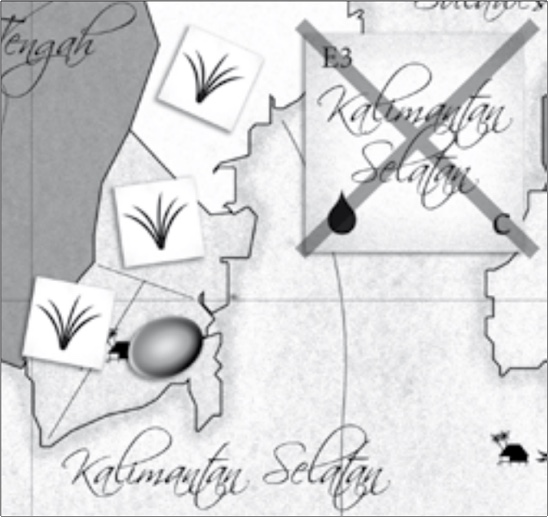
He also has to pass if there are no more size 1 city stones. After each player has built cities, discard all remaining unacquired companies from the previous era and place the next set of company deeds on the map.
Bid for Turn Order
This phase determines the order of play for the following phases. During this phase, use the order of play determined in the previous year and indicated on the order of play track. Each player, starting with the first one in order of play, bids an amount of cash once. A bid of 0 is allowed. This cash is placed in the "Bank" box on his player aid.
Whoever has the highest bid gets to be first in the order of play, whoever has the second highest result plays second, etcetera. In case of a tie between two players, their order with respect to each other remains unchanged.
If players have invested in the "Turn Order Bid" on the R&D track, their bid is multiplied by the corresponding amount—so a bid of 5 would be worth 25 for a player who has invested once in this ability. Players MUST use this ability if they have it.
The money transferred to the "Bank" box cannot be used for any reason for the remainder of the game, but does count for victory.
Mergers
In this phase, players may announce mergers, and then bid for control of the new companies. Only players who have researched at least one step on the Mergers R&D track may announce mergers—skip this phase in the beginning of the game, when no player has conducted this research yet. However, every player with a free slot and both of the owners of the companies that are being merged may always join in the bidding, even if they have performed no Mergers R&D.
Players may announce only one merger per round. The Mergers phase continues until no player wants to announce more mergers, so players can announce as many mergers as they want.
Announcing Mergers
In turn order, each player who has researched at least one "Merger" step may announce a merger. Each merger is resolved before the next is announced.
A merger always involves two companies—it is not possible to merge 3 or more companies in one step. However, a merger may involve up to five company deeds (this will happen if the merging companies are themselves the result of earlier mergers). The number of company deeds that may be involved in the merger is limited by the position on the Merger R&D track of the announcing player: merger 2 allows mergers resulting in companies of at most 2 company deeds, merger 3 allows mergers resulting in companies of 3 deeds, etc.
Each company deed can only be involved in a merger once per year—once it is merged, the resulting company cannot be merged again until the next Merger phase.
Mergers are always between two companies of the same type (rice with rice, shipping with shipping, etc.) with the exception of siap faji mergers (see below).
A player may announce a merger of two companies regardless of who owns these companies: he may own both, neither, or one of them. However, he may only announce a merger if he is allowed to hold the resulting company. In practice, this means he has to own one of the merging companies, or have a free slot.
Bidding
The announcing player must place the first bid. This bid must either be equal to the nominal value of the merged companies, or be a valid raised bid. The nominal value is calculated by counting the number of goods each company has on the board and multiplying this by the value of each good (10 for ships, 20 for rice, 25 for spices, 30 for rubber, 35 for siap faji, 40 for oil). The minimum bid is equal to the nominal value, even if the announcing player owns one or both companies himself. A player may not bid more than he has on hand. Bidding then proceeds in order of play. Every player who can own the resulting company may bid (i.e. the players with a free slot, and the owners of the merging companies).
Merger R&D does NOT influence who may bid. Players may either pass or bid. Once they pass, they cannot rejoin bidding for this merger. Bids must be raised in increments equal to multiples of the number of goods the companies have on the board—e.g., when merging rice companies with 3 and 5 goods on the board, the minimum bid of 8 × 20 = 160 can be raised in multiples of 8 to 168, 176, 184, etc.
Resolving the Merger
When all players have passed, the resulting company is given to the player who has made the highest bid. This player divides the total sum amongst the former owners according to the number of goods/ships the original companies had on the board—so if 224 was the winning bid on the 3 and 5 company above, it would be divided 84/140. Note that the acquiring player must be able to pay the total sum bid, even if he owns one or more of the original companies.
The company deeds of the original company are placed together and given to the new owner. In case of a merger between shipping companies, the type of ships is adjusted on the board so that it is easy to recognize that they now belong to one company (see suggestions on ship types). In case of a merger between production companies, no adjustments on the map are needed.
After the merger has been completed, the merger phase continues with the next player. Play continues in order of play until no player wants to announce another merger. Note that for announcing mergers, it is allowed to pass and then rejoin, as mergers announced by other players often enable a player to free up slots and announce mergers himself, resulting in a furious wave of merger activity.
Suggestions on Ship Types
As shipping companies grow large, it is often best to use both types of ships from a single color. In some cases, one color may not be enough. If this occurs, use two colors for the big company, and the other color for the other companies.
Note that no ships are ever taken off the board—even if the resulting company has multiple ships in the same area, these just remain.
One ship of each company should be positioned on the Company hull track (below the R&D track), so everyone can see at a glance what the hull capacity of that particular company is.
Siap Faji Mergers
Siap faji mergers take place between a rice and a spice company. The resulting company produces microwave meals, called "siap faji". This is the only instance where two companies producing different goods can be merged.
Siap faji mergers are resolved in the same way as normal mergers, with the following exceptions:
- A siap faji company cannot be formed in era a—only in era b or c.
- The nominal value bid is equal to the total number of goods (rice + spice) × 25.
- The total bid is divided amongst the owners of the original companies in the same way as with a normal merger—so if one player owned 4 rice and the other 3 spices, the first would get 4/7, the second 3/7 of the total price.
- After the merger is completed, the new owner must give up half of the goods (land areas) owned by the old companies (rounded up). Empty these areas of any goods. You can only give up areas at the border of your company's estate—that is, you may not break contiguous zones of spice/rice by taking goods from the middle. Replace the rice/spice goods in the remaining areas with siap faji goods. So in the example above, the resulting company would consist of 3 siap faji goods.
- If you have sufficient research, it is allowed to merge a "3"-size spice company with a 1-size rice company. The number of deeds or goods in the merging companies need not be balanced in any way.
- Once a siap faji company has been formed, it can only merge with another siap faji company. Mergers between a siap faji company and a rice or spice company are not possible.
Acquisitions
In this phase, players may start new companies, provided they have free slots for these companies. Players get multiple chances but may acquire only one company per round.
Following the order of play, each player may start one available company of the current era. He takes the corresponding company deed and places it in front of him. Starting a company costs no money. Note that a player may never have more companies than he has slots, as indicated on the R&D track. A merged company that consists of multiple company deeds takes up only one slot.
If the acquired company is a production company, the player must place one goods counter in the appropriate province. He may place this counter on any empty land area. However, a goods counter cannot be placed immediately next to a goods counter of the same type. If no such area is available, the company cannot be started and is taken out of the game.
If a player acquires a shipping company, he places a ship in one of the sea areas bordering on the province indicated. Existing ships do not hinder placement in any way.
Instead of starting a company, a player may also pass. Once a player has passed, he can no longer acquire companies during the present acquisition phase.
The acquisition phase goes on until all players have passed or until there are no more companies left. A player may acquire multiple companies in one acquisition phase, provided he has enough slots.
Research & Development
In this phase, players may each research one out of 6 available upgrade types. The player researches an upgrade by placing his marker one step forward on the corresponding R&D track. The following upgrades are available:
Turn Order Bid
Turn Order Bid indicates the amount by which the player's order of play bid should be multiplied in order to determine the sequence of play during the Bid for Turn Order phase.
Slots
Slots indicates the number of companies a player may own at any one time. Merged companies consisting of multiple company deeds take up only one slot.
Mergers
Mergers indicates the maximum number of company deeds that may be involved in a merger announced by a player. With mergers 1, a player cannot announce any mergers. With mergers 2 researched, a player may announce mergers of 2 single companies. With mergers 3, a player may announce a merger of a previously merged company (consisting of 2 company deeds) and a third, unmerged one, resulting in a company consisting of 3 company deeds. Note that the merger R&D determines only which mergers a player may announce. Players may bid for and own large, merged companies regardless of their R&D position on this track.
Expansion
Expansion indicates the maximum amount of expansion a production or shipping company may have during the operations phase.
Hull Player
Hull Player indicates the number of goods each ship belonging to a company of that player may transport for each production company during the operations phase. Each player should place one ship of each of his shipping companies directly beneath his own marker on the Hull Company track, so that everyone can see at a glance what the capacity of each shipping company is.
A player may advance the hull size on another player's R&D track instead of advancing his own capabilities. It may sometimes be useful to do this if the other player owns a strategic shipping line in order to transport and sell more of your own goods. It is not allowed to increase any other upgrade types from another player.
Operations
In the operations phase, multiple rounds occur. Rounds are played in turn order. In each round, each player operates one of his companies and places it upside down to indicate that the company has operated. The phase ends when all companies have operated once. Merged companies operate as one entity.
A player may freely choose which company to operate. He must however operate one company each round as long has he has any companies left, even if the company cannot do anything sensible (or has to do something detrimental to the player).
Operating Shipping Companies
For shipping companies, the operations phase consists of one choice: it may choose to expand.
A shipping company may expand until it has a number of ships equal to the number listed on the deed for the appropriate era (a/b/c). Remember that a new era can only start in phase 1 at the beginning of a year.
New ships may only be placed in any sea area where the company already has a ship, or adjacent to any such area. If a player has expansion "2", it is allowed to place the second ship in an area that has just been "opened up" by the first ship. The number of ships a player may add in a round is indicated by the position he has on the Expansion track in the R&D table. So if the owner has expansion 2, he may add at most 2 ships per company, provided this does not bring the company over its limit.
Merged shipping lines add the numbers on their respective deeds. So if Lampung (2/3/4) merged with Halmahera (3/4/5), the resulting company would be able to float (5/7/9) ships. These ships can be placed adjacent to any of the companies' existing ships—the location of the original deeds does no longer matter.
Operating Production Companies
Production companies operate by doing three things in order: sell goods; receive income; and expand. In this paragraph, mention will often be made of production areas. A production area consists of a number of adjacent areas producing the same good. A production area always belongs to one company.
Goods are sold to cities. A size 1 city will buy one of each type of good that is produced on the board at that time—so 1 rice, 1 spice, 1 rubber, etc. Goods that are not produced anywhere on the board are not required. A size 2 city will buy 2 of each good, a size 3 city will buy 3 of each. The goods are not physically moved on the board. Instead, place an upside-down counter of the same good (showing that good in transit) next to the city it is sold to. In this way, it is easy to see whether a city will accept any more goods of that type.
A company can only sell goods to a city if there is a chain of ships of one shipping company connecting the producing area with the city. So there has to be a ship in one of the sea areas adjacent to the city area. If this area is not adjacent to at least one of the production areas, it needs to be connected to another ship that is. Goods can be freely moved from an area to a neighboring area within a production zone, so it is not necessary for each area to be next to a ship. It is not possible to move goods to a city over land, not even if the producing area is right next to a city.
If a company has multiple production zones (this can only happen as the result of a merger) each production zone has to be treated separately, and needs its own shipping. In other words, goods cannot move freely between areas of a company that are not adjoining. For each good that is sold, the production company needs a chain of ships owned by one company. A merged company counts as one company in this respect.
He may use chains of different companies for different goods, but he cannot let goods "switch company" in the middle of a chain.
Each ship can transport only one good for each production company, unless the owner of the ships has developed a larger hull size—for each additional step on the hull R&D track, the ship can be used once more by each production company. Whereas the demand of each city is limited during the entire phase, all ships can be used anew by the next production company.
The owner of the production company gets a fixed fee depending on the type of goods sold: 20 for rice, 25 for spice, and so on (see the table on the player aid). Out of this money, he has to pay 5 for each ship he uses to the owner of the respective shipping companies. If he uses a ship of hull 2 twice, he has to pay twice as well. The easiest way to keep track of this is to place 5 rupiah coins from the game on the different ships used and to give these coins to the owners afterwards, subtracting the sum from the amount earned by the production company.
Production companies have to sell as many of their goods as they can, even if this means they have a negative income due to transport costs on one or more of their goods.
If a company has sold all its goods, that is, as many goods as it currently has on the board, it must expand for free. The player expands 1 or more areas, depending on his R&D expansion track status. These areas must be adjacent to one of the production zones of the company. A company can only expand into empty territory: a city or another company blocks the way. It is also not allowed to expand over sea areas, unless the two land areas are connected by an arrow.
Finally, it is not allowed to expand in such a way that production zones of two companies producing the same product would merge (so you can always distinguish companies). If there is no room to expand, a company cannot do so.
Merged companies can only expand once, i.e., if a player has expansion 2 he can place 2 extra goods in total. He may choose to place these anywhere in the area of the company, so the two newly produced goods can be in vastly different places on the map.
If a company has not sold all of its goods, it may invest to expand. It can buy expansions (with the placement subject to the above rules) up to the number indicated on its R&D expansion track. The price per area is equal to that of the type of good the company is producing (e.g. 20 for each rice expansion, etc.). The money is paid into the general cash reserve.
After the company has operated, turn it upside down. The next player then operates one of his companies. As soon as all companies have operated, the next phase starts.
Last Earnings Double
Because all money earned in the final operations phase is doubled, players should keep their earned money separate in the last era. If the game continues to another round, move it to cash at the beginning of the next year. If the game ends, double the money collected during the year, add the sum to cash, and count who has won. If you operate a company with negative profit (that is, it has to pay more for shipping than it earns), you must pay from this stack, not from your overall money. If there is no money in this phase's stack yet, write down the money you have to pay and take it out of the stack later in the phase (this happens rarely), or, if you make no money at all, double the negative value at the end of the phase and pay that amount.
City Growth
In this phase, cities grow if they have received every good that is produced on the board up to the full potential of the city: a size 1 city needs one of every good on the board to become a size 2 city. A size 2 city needs 2 of every good to become a size 3 city. Discard all delivered goods, regardless of whether the city grew larger.
Replace the city with a stone of the appropriate color. (size 1 is colored green, size 2 is yellow, and size 3 red). If there are no more tokens available, it is not possible to upgrade a city.
If there are multiple cities that can be upgraded, but not enough tokens, the player who is first in order of play chooses which cities to upgrade.
Note that a city needs only those goods that are being produced on the board. In the first years, there is never any rubber, siap faji or oil, and it can even happen that there are no spices.
In this case, the city needs only rice to grow! In some games, a similar situation occurs towards the end: if all rice and spice companies merge into siap faji companies, cities no longer require rice or spice to grow.
Two-player Game
If the game is played by two players, give each player two city building cards of each era at the start of the game. Whenever new cities are built in a New era phase, both players build two new cities each, alternating between the players.
Victory Conditions
The game ends in the "New Era" phase if the "c" era ends: that is, if there is only one type of c era company left to acquire, or if all c era companies have been acquired in the last year.
Any cash earned in the last operations phase is doubled, the player with the most money (including money in the bank) wins. In case of a tie, the player who is first on the order of play wins.
Rules Clarifications
What Is the Situation Around Bali and Jawa Timur?
There are three different seas as shown on the picture—one sea north of Jawa Timur (number 1), one sea south of Jawa Timur (number 2), and one sea surrounding Bali (number 3). Sea 1 is not adjacent to sea 2, though both are adjacent to sea 3. The western area on Bali (area A) is adjacent to all three seas.
Maluku
Maluku covers all of the white islands and island clusters in the general region of the name Maluku on the map. One of the B city building cards which has Maluku shaded is missing shading from the topmost island cluster, but this is a misprint.
Symbols
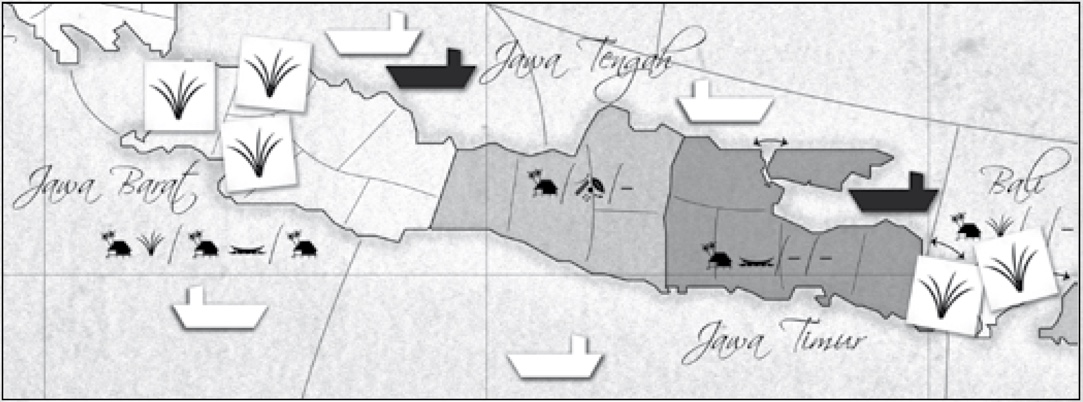
The symbols indicate a region's "potential" by era, with the eras separated by '/'. The symbol indicates either a production company, a shipping line, or a city. The hut is the mark for a city.
So let's look at Java Barat:
In Era A, Java Barat will be on one or more of the city cards and there will be a rich production company available. In Era B, Java Barat will again be on one or more city cards and there will be a shipping company available. In Era C, Java Barat will be on one or more city cards, but no production/shipping companies in that region.
The dashes just indicate that nothing is available in that era. For example, Sumatra Barat:
In Era A, Sumatra Barat has no city cards or companies. In Era B, Sumatra Barat appears on one or more city cards and a rubber production company is available. In Era C, Sumatra Barat has no city cards or companies.
The marks help one realize where developments (cities or companies) will be available in future eras and are helpful for planning expansions.
Strategic Hints
In the first year, make sure you get a nice company, and try to find some friends in order to have a good first year. Plan your R&D carefully. Starting with increasing slots is often a good strategy, or at least a safe one.
As the game progresses, make sure to have open slots for the more lucrative types of companies when they come up: rubber in the b era, and oil in the c era. It is often the case that only one or two rubber (and oil) companies can start really well—and it is often the owner of the shipping lines who decides which one!
Shipping companies are a good stealthy way to make money. They do not seem to earn much but can be very lucrative towards the end of the game—especially if you count the fact that you do not have to pay your own shipping fees. Even more importantly, owning the right shipping company often gives you the option to determine which areas are going to develop, and which aren't. However, to make your company really useful you will have to merge it into a shipping emporium of 3 or more companies...
The game revolves around mergers. Although it is of course important to own the right companies and operate them well, Indonesia fortunes are made or broken during the merger phase. Make sure you always have enough cash to defend your own crown jewels, and to prevent "raids" on poor players.
Mergers can be done for many reasons: to get someone else's company, to sell your own company and raise cash, to get a free slot, to take advantage of an order of play position, to speed up the game, to influence the direction of shipping lines, to increase or decrease the hull size of a particular shipping route, etc... as you gain experience you may discover even more different reasons to initiate mergers...
One subtle thing to keep in mind is the order of play: think about when you would like to be the first to move, and plan ahead. Order of play can be very crucial, especially in the later phases!
Have fun playing Indonesia, The Splotter Team
Colophon
Game design: Jeroen Doumen, Joris Wiersinga
Concept creation: Tamara Jannink
Graphic design: Ynze Moedt, Jeroen Kesselaar
Rule translations: Birgit Hugk, Torsten Hintz
Published by: Splotter Spellen, Langestraat 22, Leiden, The Netherlands, info@splotter.nl, ww.splottershop.com
Playtesting: Hartmut Benz, Ileana Buhan, Beata Czenko, Marcin Czenko, Jeroen Doumen, Bianca van Duijl, Ferdy Hanssen, Alan How, Tamara Jannink, Ragnar Krempel, Maria Lijding, Raluca Marin-Perianu, Ynze Moedt, Mihai Marin-Perianu, Michel Rosien, Pieter Simoons, Lodewijk Smit, Henriëtte Verburg, Joris Wiersinga, Anna Zych, Arthur Zonnenberg. Thank you! Apologies if you are not on the list!
Comments & Questions: A special thank you to all those people who bought our game and then wrote questions and comments on the web which have helped us improve the rules for this edition. Apologies if you are not on the list!
Doug Adams, Phil Alberg, Josh Bluestein, Dan Blum, David Bohnenberger, Malcolm Booker, A Brian, Lajos Brons, Eric Brosius, Mark Casiglio, Slim Chabbouch, Brad Cooley, Bruce Coram, Steve Cox, Derk, Dietevil, Jean-Roger Duvauchelle, Dave Eisen, Eric, Kenrick Fearn, Adriaan de Goeij, S. Graber, Darrell Hanning, Ron K, Enes Kadioglu, Daniel Karp, Steve Kearon, Chris Kolenda, Chad Krizan, Johan L, J C Lawrence, Joe Lee, Daniel Lokemoen, Lolo Mac, John McCoy, Mikko, Joshua Miller, Msaari, Ray Mulford, Ben Nevis, Nicolas, Richard Pardoe, Andrew Rintoul, Bill Romaniecki, Jennifer Schlickbernd, Colleen Simmons, Ben Spicher, John Weber, Andrew Young, Michelle Z.